

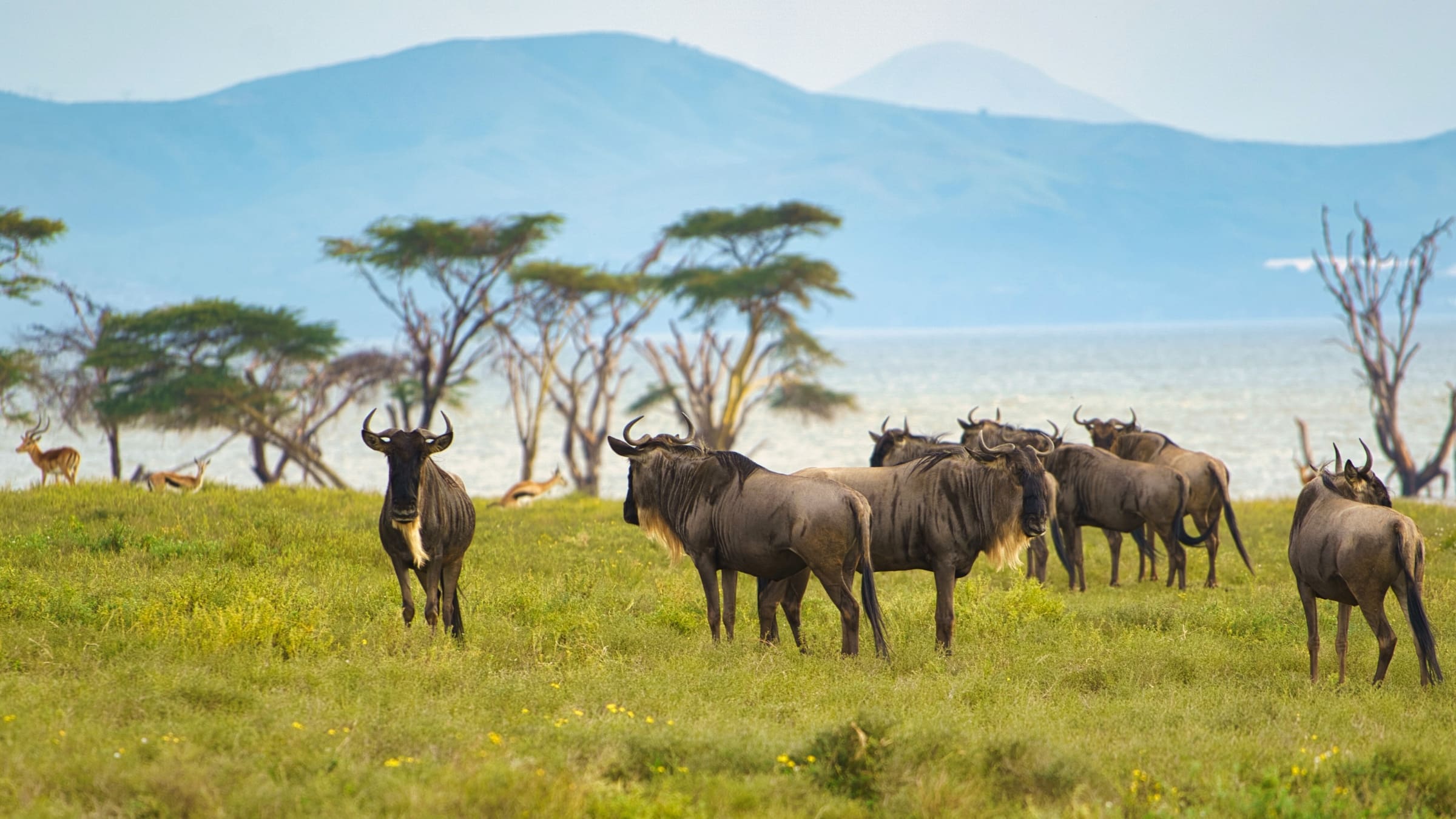
The rugged, pure nature where you can admire the world’s largest and most special land animals in all its glory. And no safari in Kenya is complete without looking the King of the Savannah straight in the eye, counting the stripes of the zebra, or passing gracefully galloping giraffes as the setting sun shines its golden rays over the vast plains. Welcome to the safari parks of Kenya!
 Crème de la crème of safari parks and world famous. The largest park in Kenya and filled to the brim with wildlife. The vast rolling plains of the Mara are perfect for spotting animals: there is a good chance that you can tick off the Big Five here! And you came for that, didn’t you?
 The Masai Mara is home to the densest population of large predators in the world, including the African lion. However, the lion population has halved in the past twenty years, leaving around 600 lions roaming the plains of the Masai Mara. Yet, like the Tanzanian Serengeti, this park is best known for The Great Migration. During this spectacle, which spans several months, some one and a half million wildebeests and a few hundred thousand zebras and gazelles cross the Mara River. This is mainly due to rainfall. When the rainy season begins in the Northern Mara, they move towards the plains of the Serengeti. And during the drier times they slowly retreat to Kenya. The rain has left behind fresh, green grass and fertile grounds for the animals to eat their bellies around.
 Welcome to “The home of the African elephant!” In Amboseli National Park, you not only get to see stomping elephants but also the famous Kilimanjaro. While you can’t take your eyes off that mountain, the lions, giraffes, zebras and antelopes will come hobbling past your safari van. Although it is a relatively small park, it is incredibly diverse. The wet soils provide a varied habitat. Open your ears and hear the laughter of a hyena. Who knows, you might see them devour their prey! Bird lovers will also get their money’s worth during this safari in Kenya. In Amboseli you can find more than 600 bird species. Especially between November and January, it is useful to bring your binoculars: then most of our winged friends spend the winter in the park.


 Nairobi is the only city in the world with a National Park. In some parts you imagine yourself in the middle of nature, but you also often spot wildlife with the city skyline still in the background. Dozens of lions and rhinos have this as their home base and it is unbelievable that there is so much wildlife so close to the city! At times you forget where you are. In the tall grass, the search for a white rhino or while spotting fighting zebras. At the next bend, the skyline resurfaces and you are reminded that animals once lived all over Nairobi, but the construction of the city has reduced their habitat.
Did you already know this about safari in Kenya?
- Kenya has 22 national parks and 32 nature reserves.
- In Kenya you will find the entire Big Five in almost all national parks.
- A safari in Kenya is often best in the high season when the grass is lower and all animals gather around scarce water sources. Easy to spot!
- The African elephant you can see here is the largest land animal in existence.
- Safari in Kenya does not only mean savannah scenery: how about volcanic rock formations, lakes full of flamingos or thundering waterfalls in jungles?
- At many national parks you can visit the Masai; Kenyan populations who adhere to traditional customs.
# 1 The Masai Mara
What you need to know about the Masai Mara!- The Masai Mara is the same area as the famous Serengeti in Tanzania: but a national border separates them. This safari park is therefore located in the south of Kenya.
- The Masai Mara is about 1700 km2 in size.
- The Masai Mara is located at an altitude of 1500 to 2100 meters.
- The landscape of the Masai Mara consists mainly of grass plains with acacia trees and river forests. Two rivers flow through this landscape: the Talek and – surprise! – the Mara.
- The best time to go to the Masai Mara is in July, August, October and November. Then you can admire the spectacular Great Migration.
- July, August, October and November are also the drying seasons. The sun is shining and because of the altitude, it is not too hot.
- In the dry season, you can spot most animals: the grass is lower and the water sources scarce: all the animals come together there to drink!
- From December to May you will find the park in the wet season. The most rain falls in April. Then the roads become slippery and it is difficult to navigate!
Crème de la crème of safari parks and world famous. The largest park in Kenya and filled to the brim with wildlife. The vast rolling plains of the Mara are perfect for spotting animals: there is a good chance that you can tick off the Big Five here! And you came for that, didn’t you?
The great migration
The Masai Mara is home to the densest population of large predators in the world, including the African lion. However, the lion population has halved in the past twenty years, leaving around 600 lions roaming the plains of the Masai Mara. Yet, like the Tanzanian Serengeti, this park is best known for The Great Migration. During this spectacle, which spans several months, some one and a half million wildebeests and a few hundred thousand zebras and gazelles cross the Mara River. This is mainly due to rainfall. When the rainy season begins in the Northern Mara, they move towards the plains of the Serengeti. And during the drier times they slowly retreat to Kenya. The rain has left behind fresh, green grass and fertile grounds for the animals to eat their bellies around.
A gruesome spectacle
Unfortunately, there are many animals who never get their coveted grass meal. The crossing of the Mara is dangerous! Because even the crocodiles know that this rainy season serves their dinner: but in the form of fresh herbivores that pass straight through their river. Do you remember these scenes from television? The galloping wildebeest, the frantic zebras, the splashing water and the crocodiles with bloody gazelle legs between their jaws? Only now are you on the sidelines of such a cruel spectacle. This nature is not for the faint-hearted!#2 Hell’s Gate National Park
What you need to know about Hell’s Gate National Park!- Hells’ Gate is located northwest of the capital Nairobi, nestled against Lake Naivasha.
- Hell’s Gate is located on a plateau of 1900 meters, around the crater of the dormant Mount Longonot volcano.
- Hell’s Gate is the only national park that you can cycle and walk through!
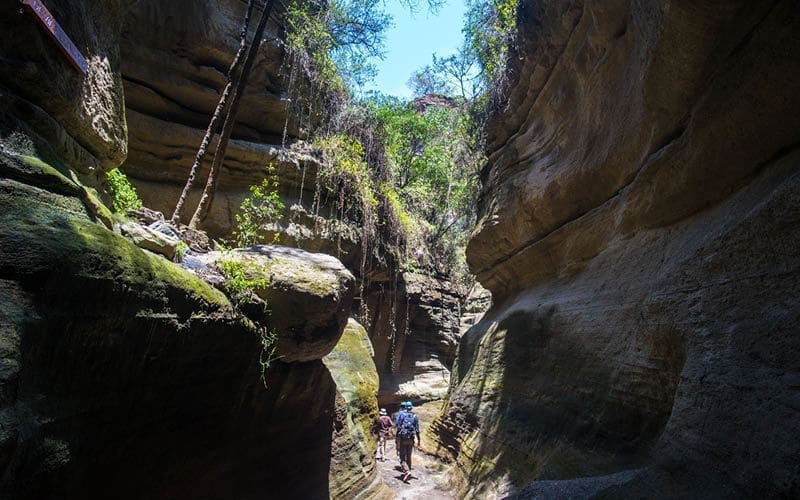
- This creates a wild and rugged landscape of cliffs, gorges, cracks and volcanic rocks that tower up from the landscape.
- The dry season is from June to October. Now is the best time to go! It is sunny and not too hot. The grass is lower and the animals gather around the scarce water sources. So easy to spot!
- The wet season is November to May, with the heaviest rainfall between April and May. Benefit? The landscape is spectacularly green, with no dust in the air and an explosion of flowers. Many new animals are also being born. Downside? The rain and mud can disrupt your cycling or hiking plans.
The Great Rift Valley
Hell’s Gate National Park is part of the Great Rift Valley: two tectonic plates that slid apart slowly, leaving a valley behind. From the Red Sea in Turkey, all the way to Mozambique! Long ago, Hell’s Gate was a tributary of a prehistoric lake that fed the ancient inhabitants of the Great Rift Valley. Today this is reflected in the landscape: Winding, erratic cracks in the rocks and eroded rock walls form narrow passages, sometimes several meters wide. A popular route for hiking!Lion King landscape
Does this image sound familiar to you? You can, because the tear-jerking Lion King is based on this valley. That one scene where Mufasa is overrun by a herd of hunted wildebeest. Poor Simba, who was left here all alone … Are you crying? That one! Today, unfortunately, there are no more lions sneaking through the tall blades of grass, so you can ride around on your steel steed.#3 Amboseli National Park
What you need to know about Amboseli National Park!- This park is located in the southwest of Kenya, close to neighboring Tanzania.
- Amboseli National Park is characterized by the majestic Kilimanjaro looming on the horizon.
- Amboseli National Park is 392 km2, but is actually part of an ecosystem of 8000 km2; spread across Kenya and Tanzania.
- In this park you will find diverse habitats: from the dried-up bottom of Lake Amboseli to vast savannah plains, to moist swamps with water sources to forest landscape.
- In Amboseli National Park it can be quite dry: because the park is crowned with Kilimanjaro where the air often gets rid of moisture: above is simply the rain and snow that does not fall down in the Amboseli!
- Yet there are two rainy seasons: in April, May, October, November and December.
- In Amboseli National Park, spotting wildlife is easiest during the dry season because water is scarce, and animals gather there.
Welcome to “The home of the African elephant!” In Amboseli National Park, you not only get to see stomping elephants but also the famous Kilimanjaro. While you can’t take your eyes off that mountain, the lions, giraffes, zebras and antelopes will come hobbling past your safari van. Although it is a relatively small park, it is incredibly diverse. The wet soils provide a varied habitat. Open your ears and hear the laughter of a hyena. Who knows, you might see them devour their prey! Bird lovers will also get their money’s worth during this safari in Kenya. In Amboseli you can find more than 600 bird species. Especially between November and January, it is useful to bring your binoculars: then most of our winged friends spend the winter in the park.
Motorsafari
Don’t feel like sitting in a dull safari van here? We have the solution. A safari by motorcycle! Rough, tough and wonderfully off-beat. The people have drawn beautiful land borders for the parks, but do you really think the animals adhere to them? Of course not! The wildlife just wanders where they find it interesting and that’s how you come across an elephant while you are cruising around on your motorcycle! And go!#4 Aberdare National Park
What you need to know about Aberdare National Park!- Aberdare National Park is located in central Kenya and on the east side of the Rift Valley.
- This park is located 100 km north of Nairobi, with altitudes varying from 2000 to 4300 meters!
- Aberdare National Park is 766 km2 in size.
- In this park you will find not only savannahs, but also mountains, waterfalls and jungle.
- Aberdare National Park is known for the rare beasts that live here. Just think of the African golden cat, the black leopard or the gigantic Eastern Bongo (a kind of jungle gazelle). You do need a four-leaf clover if you want to encounter it!
- The dry season is between July and October. Now is the best time to go! It is then sunny and at the same time cool, with average temperatures between 21 and 23 degrees.
#5 Lumo Conservancy
What you need to know about Lumo Conservancy!- Lumo Conservancy is a community-owned, protected area of 40,000 hectares.
- Lumo Conservancy was founded in 1997 when three ranches merged their plots of land. These ranches were called Lualenyi, Mramba and Oza. That is why this conservancy is called Lumo!
- This conservancy is an extension of Tsavo West National Park.
- It is not exactly close to Nairobi or Mombasa: it is a long and tiring journey by car. So drive away early or cut the trip in half by spending the night at a stopover!
- The roads are well maintained and smooth. The grass is low so you have a wide view to the horizon.
- In the wet season you can spot wildlife less well because all the animals are spread over the park! However, prices can be lower in this season.
#6 Lake Nakuru National Park
What you need to know about Lake Nakuru National Park!- Nakuru National Park is 188 sq km, not far from Nairobi!
- This park was established in 1961.
- This park is located at the bottom of the Great Rift Valley and is surrounded by bushy grasslands.
- Nakuru means “dust” or “dusty place” in the local language of the Maasai.
- The dry season is from June to February… Hardly any rain! However, it can get busy in the park, and you will spot many tourists and safari jeeps through your binoculars.
- The rainy season is from March to May. The park is greener with lots of flowers! Because a fence has been built around the park, the animals cannot get out. That is why you can easily spot them in this season. In April it rains a lot. Keep in mind that you will get stuck in the mud!
Other game
Fortunately, this park has even more to offer than these pink flutterers, namely rhinos! This park is also officially crowned as a sanctuary for the giant and endangered animals. There are now 25 black rhinos in the park and over 70 white rhinos next to those thousands of flamingos. If you want to check lions, cheetahs, and leopards off your bucket list, or even encounter large pythons leaving their skins in the woods, then you're in the right place!#7 Tsavo National Park
What you need to know about Tsavo National Park!- Tsavo National Park is located in the south of Kenya between Nairobi and the coast.
- Tsavo National Park consists of two parts: East and West. At 22000 square kilometers, Tsavo is the largest and oldest park in Kenya.
- You can drive right through Tsavo by car or train.
- Here you will find a vast landscape of red earth and acacia trees. Tsavo is known for its red-colored elephants, as they dig through the red soil.
- Cat people pay attention: you can spot many big cats here.
- The climate is hot and dry: during the day it will be around 31 degrees and at night it will cool down to about 20 degrees.
- Dry seasons, from June to September, are the coolest.
The man-eating lions
This park has been the stage for an impressive history. With the famous man-eating lions – lions that roamed here and ate the railway workers one by one – the park has a pretty gory history. But no worries: those times are over. Here you will find rugged rocks and dense bush which only increases the excitement of the safari. Because is the great-great-nephew of the man-eating-lion sneaking past that bush?Straight through the park
You do not have to pay a permit and arrange a game drive to check off this park. When you go from Nairobi to the coast – or vice versa – you cross right through this park. The railway has recently been renewed and it zooms between the bustling cities of Mombasa and Nairobi in just five hours. Take a good look through the window, because an elephant or herd of zebras is regularly watching!#8 Nairobi National Park
What you need to know about Nairobi National Park!- Nairobi National Park is about 117 km2.
- This park is located about 7 km south of the center of Nairobi.
- Electric fences have been built on three sides of the national park. The south side has been left open to allow animals to migrate between this park and the adjacent Kitengela plains.
- The landscape of Nairobi National Park consists mainly of vast and open grassy plains with acacia trees.
- When in Nairobi, it is fun to game drive and have a picnic! Are you planning to go on safari in one of the above mentioned parks in Kenya? Then it might be more fun to explore the city life of this metropolis.
Nairobi is the only city in the world with a National Park. In some parts you imagine yourself in the middle of nature, but you also often spot wildlife with the city skyline still in the background. Dozens of lions and rhinos have this as their home base and it is unbelievable that there is so much wildlife so close to the city! At times you forget where you are. In the tall grass, the search for a white rhino or while spotting fighting zebras. At the next bend, the skyline resurfaces and you are reminded that animals once lived all over Nairobi, but the construction of the city has reduced their habitat.